
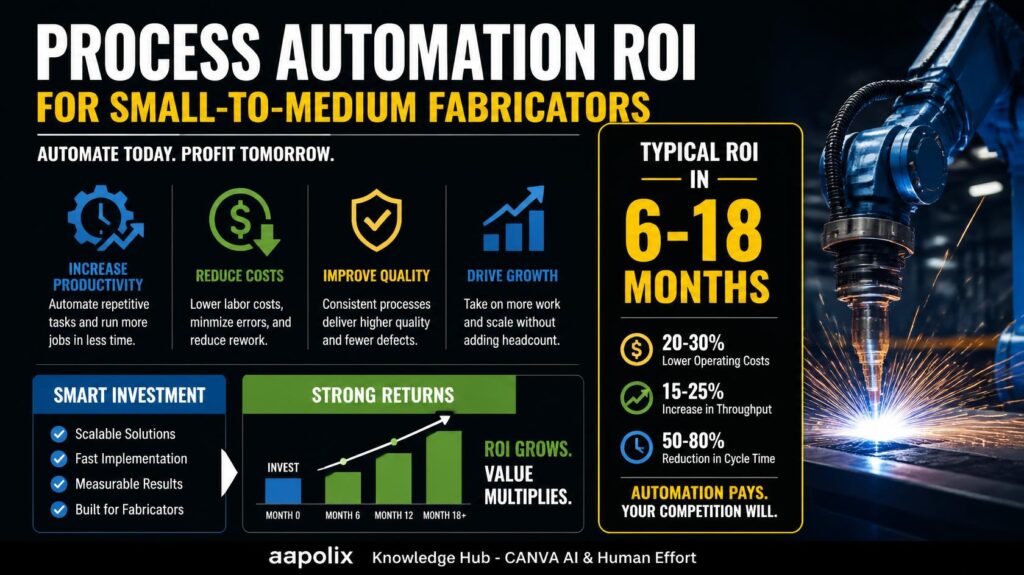
Why ROI Matters Before Automating a Fabrication Process
Fabrication businesses often operate with tight margins. A few minutes lost on every job may not look important. A missed follow-up may look like a sales issue. A production delay may look like a planning issue. A repeated data-entry task may simply feel like part of the job.
But these small problems add up. Consider a fabrication company receiving enquiries for laser cutting and sheet metal fabrication.
The sales person receives the enquiry by email. The drawing is forwarded to production. Someone checks material requirements. A quotation is prepared. The customer asks for a revision. The revised quotation is sent again. A few days later, somebody has to remember to follow up.
None of these steps is particularly difficult. The problem is that the same work happens again and again. Process automation becomes useful when it removes this repeated effort without making the workflow more complicated.
What Does ROI Mean for a Fabrication Business?
ROI, or return on investment, is not only about increasing sales.
For a small fabrication company, automation can create value in several ways.
- Reducing administrative time
- Reducing data-entry errors
- Reducing missed follow-ups
- Reducing production delays
- Reducing unnecessary movement of information
- Improving quotation turnaround time
- Improving machine and employee utilisation
- Improving visibility across jobs
- Reducing rework caused by missing information
- Helping the team handle more work without adding the same amount of administrative effort
This means the ROI calculation should look at the complete business process, not just the cost of the automation software.
Start With the Process, Not the Software
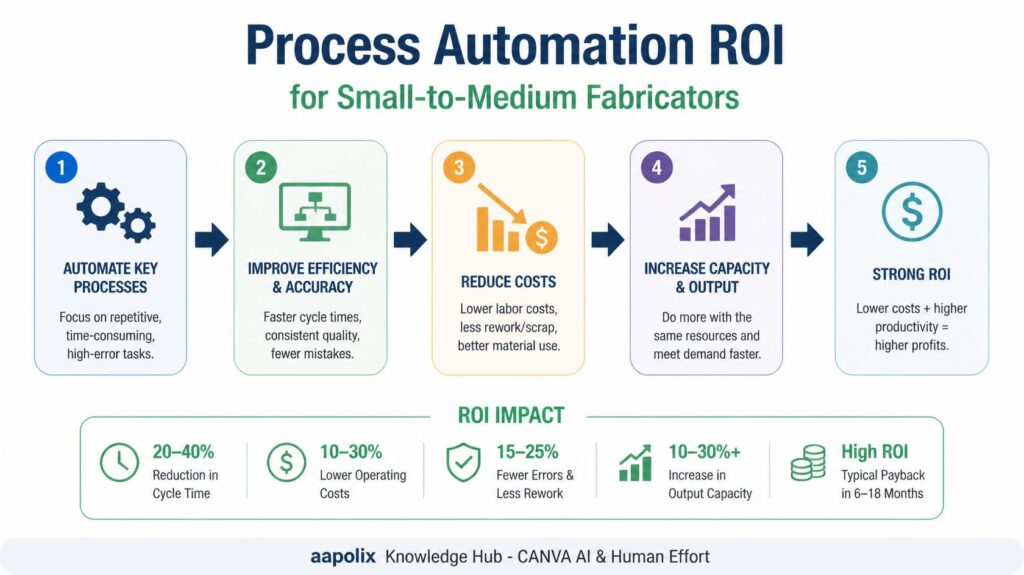
This is where many automation projects go wrong. A company finds a new software platform and then tries to change its business around the software. For a fabricator, the better approach is to start with the actual workflow.
Take a typical enquiry:
Enquiry → Requirement Review → Technical Check → Quotation → Follow-up → Order → Production → Inspection → Dispatch → Repeat Order
Now ask a simple question at every stage:
What is being done manually, repeatedly or without clear ownership?
That is where automation opportunities usually appear.
Where Small Fabricators Commonly Lose Time
The biggest automation opportunity is not always inside the production machine. It can be around the machine.
1. Enquiry Handling
A customer may send an enquiry with drawings, material details, quantities and delivery requirements. If the information is manually copied into another system, the same person may spend several minutes recording information that already exists.
An automated enquiry process can capture the basic information and create a structured job or sales record.
2. Quotation Follow-up
A quotation can be prepared correctly and still be forgotten. When follow-ups depend entirely on memory, some opportunities will naturally be missed.
Automation can create reminders based on quotation date, customer response or sales stage.
3. Job Status Updates
Production managers, sales teams and customers may all ask the same question:
Where is the job?
If the answer requires a phone call to the shop floor every time, people are spending time looking for information instead of using it. A simple workflow can make job status visible to the people who need it.
4. Purchase and Material Requests
Material shortages can create production delays. If purchase requirements are communicated through informal messages, there is a greater chance that information will be missed or delayed.
A structured approval and purchase request workflow can make the requirement, owner and status clearer.
5. Production Handover
Fabrication jobs often move between cutting, bending, welding, machining, finishing, inspection and dispatch. If each department receives information differently, employees spend time confirming what should happen next.
A workflow can standardise the handover between stages.
How to Calculate the ROI of Process Automation
The calculation does not need to be complicated. Start with the current cost of the manual process.
A simple calculation is:
Annual Manual Cost = Time Spent × Labour Cost × Working Days
Then compare this with the cost of automation.
Automation ROI = (Annual Benefit − Annual Automation Cost) ÷ Automation Cost × 100
The important part is estimating the annual benefit realistically. Do not count every theoretical saving as actual savings.
If automation saves one employee 30 minutes a day, that does not necessarily mean the company can reduce payroll by half an hour every day. The real benefit may be that the employee can spend that time on quotations, customer follow-ups, production planning or quality work.
Example: Automating Quotation Follow-ups
Imagine a fabrication company prepares around 150 quotations every month. Each quotation requires manual follow-up. Suppose the sales team spends an average of five minutes checking and recording follow-up activity for each quotation.
That is:
- 150 quotations × 5 minutes = 750 minutes
- 750 minutes = 12.5 hours per month
- 12.5 hours × 12 months = 150 hours per year
That is 150 hours spent on a repetitive administrative activity. If automation reduces most of this work, the company has created time that can be used elsewhere.
But there may be another benefit.
If automated reminders also reduce the number of quotations that are forgotten, the business may recover additional opportunities. That sales benefit should be measured separately from the administrative time saving.
Measure More Than Labour Savings
One of the biggest mistakes in automation ROI calculations is looking only at employee hours. For a fabrication business, the bigger financial impact may come from improved process performance.
Quotation Turnaround Time
Measure how long it takes to move from receiving an enquiry to sending the quotation. If automation reduces unnecessary waiting between sales and technical teams, quotation turnaround may improve.
Follow-up Rate
Measure how many quotations receive a planned follow-up. This shows whether the sales process is becoming more consistent.
Order Conversion
Measure how many qualified quotations become orders. Automation does not automatically improve conversion, but better process visibility can help the sales team follow opportunities more consistently.
Rework
Track jobs that require rework because of missing information, incorrect specifications or communication gaps. If automation improves information flow, rework may reduce.
Production Delay
Measure delays caused by missing material, incomplete drawings, unclear instructions or waiting for approvals. This can be more valuable than saving a few minutes of office administration.
Track the Cost of Manual Work
Before automation, spend a few weeks measuring the existing process.
For each workflow, record:
- Number of jobs or enquiries
- Time spent on each activity
- Number of people involved
- Number of handovers
- Number of corrections
- Number of delays
- Number of missed follow-ups
- Number of repeated data-entry activities
This creates a baseline. Without a baseline, it is difficult to prove whether automation actually improved the process.
Choose the Right Automation Level
Not every fabrication company needs a large software system. Automation can be introduced in stages.
Level 1: Simple Automation
This can include automatic notifications, reminders, enquiry capture, document templates and basic approval workflows.
These are often good starting points because they solve repetitive administrative work without changing the entire system.
Level 2: Connected Workflows
The next stage connects different parts of the business.
For example:
Website Enquiry → CRM → Sales Owner → Technical Review → Quotation → Follow-up
Another workflow could connect:
Sales Order → Production Planning → Job Status → Inspection → Dispatch
The purpose is to reduce repeated information entry and make the next action clear.
Level 3: Integrated Business Systems
When the business becomes more complex, CRM, ERP, production planning, inventory, finance and other systems may need to work together. This requires more planning because an error in one system can affect other parts of the business.
For a small-to-medium fabricator, reaching this level should be based on an actual business need rather than software availability.
Do Not Automate a Broken Process
Automation can make a bad process run faster. That does not make it a better process. Suppose a fabrication company requires four approvals for a simple quotation because the process has grown over several years.
Automating all four approvals may save manual work, but the better solution may be to remove unnecessary approvals first.
The right sequence is:
Understand → Simplify → Standardise → Automate → Measure
This approach usually creates a cleaner system.
Measure the Payback Period
ROI tells you whether an investment creates value, but the payback period tells you how quickly the investment can recover its cost.
A simple calculation is:
Payback Period = Automation Cost ÷ Monthly Benefit
For example, if an automation project costs ₹1,20,000 and produces an estimated monthly benefit of ₹20,000, the simple payback period would be six months.
This is only an example. Actual savings depend on labour cost, process volume, adoption and the type of automation implemented.
The calculation becomes more useful when the business tracks actual results after implementation.
What If Automation Does Not Save Employees?
This is an important question for small businesses. Suppose automation saves two hours every day but the company does not reduce headcount. That does not mean the automation failed.
- The saved time can be redirected towards activities that generate more value.
- A sales coordinator can spend more time following up with customers.
- A production manager can spend more time planning jobs.
- An owner can spend more time developing new customers.
- A quality team can spend more time preventing repeat problems.
The business should therefore measure productive capacity, not only labour reduction.
Build an Automation ROI Dashboard
A small fabrication company does not need a complicated dashboard.
A simple monthly review can include:
- Number of enquiries received
- Average quotation turnaround time
- Number of quotations sent
- Quotation follow-up rate
- Quotation-to-order conversion
- Average job cycle time
- Production delays
- Rework incidents
- Administrative hours saved
- Automation cost
- Estimated financial benefit
Reviewing these numbers every month makes it easier to see whether the automation is delivering the expected result.
Start With One High-Value Workflow
Do not try to automate the entire fabrication business at once.
Choose one process where the problem is already visible.
For example:
- Quotation follow-up
- Enquiry management
- Production status updates
- Material request approvals
- Quality inspection records
- Dispatch notifications
Measure the current process. Automate it. Measure it again. Then decide whether the next process should be automated.
This keeps the investment controlled and gives the team time to adapt.
Process Automation Should Connect the Business
For many fabricators, automation starts with one problem but eventually exposes another. A company may automate enquiry capture and then realise that sales cannot see production status. Production may have a digital job tracker, but sales may still be using a spreadsheet.
The next step is not necessarily more software. The next step is connecting the workflow.
For Aapolix, this is where MANAGE connects with REACH and CONNECT.
REACH can bring the right business enquiries through search, content and digital channels.
CONNECT can help capture and manage those enquiries through landing pages, CRM and sales workflows.
MANAGE focuses on what happens after that — the internal processes, handovers, automation and operational visibility needed to handle the work properly.
The objective is not to add more tools. The objective is to make the business easier to run.
The Real ROI of Automation
The best result of process automation may not appear as a separate line in the accounts.
- It can be seen in how the business operates.
- The salesperson knows which quotations need attention.
- The production manager knows which jobs are waiting.
- The purchase team knows which materials are required.
- The owner can see where work is getting delayed.
- The customer receives a faster response.
- The team spends less time asking, “What happened to this job?”
- That is the practical value of automation.
For a small-to-medium fabricator, the goal should not be to automate everything.
The goal is to remove unnecessary work, improve visibility and give the team more time to do the work that matters.
Conclusion
Process automation should be treated as a business investment, not simply a technology purchase. Start by identifying where time, information or opportunities are being lost. Measure the current process.
Simplify it. Automate the repetitive parts. Then measure the result again.
For fabrication companies, even a small improvement in quotation response, follow-up, production coordination or rework can create meaningful value when the process happens every day. The right automation is not the system with the most features. It is the system that solves a real business problem and produces a result that can be measured.
Frequently Asked Questions
How do you measure the ROI of process automation?
Start by measuring the current cost of the manual process, including time spent, labour effort, errors, delays and missed opportunities. After automation, compare these numbers with the automation cost and the measurable business benefits.
What processes should a fabrication company automate first?
Good starting points include enquiry management, quotation follow-ups, production status updates, material requests, approvals, quality records and dispatch notifications. The best starting process is usually one that is repeated frequently and currently creates visible delays or administrative work.
Does automation ROI only mean reducing employee costs?
No. Automation can create value by saving administrative time, reducing errors, improving quotation response, reducing delays, increasing productive capacity and helping the team manage more work without adding the same amount of administrative effort.
How long should a fabrication company measure a process before automating it?
There is no fixed period for every business. The company should collect enough information to understand normal workload, time spent, delays and recurring problems. A few weeks of consistent measurement can provide a useful baseline for many routine processes.
Should a small fabrication company automate its entire business?
No. It is usually more practical to start with one high-value workflow, measure the result and then expand automation where there is a clear business need. This reduces implementation risk and gives employees time to adapt.
What is the payback period for process automation?
The payback period depends on the cost of automation and the measurable monthly benefit. A simple calculation is automation cost divided by monthly benefit. Actual results depend on process volume, labour cost, adoption and the type of automation implemented.
Can automation improve fabrication production without replacing employees?
Yes. Automation can reduce repetitive administrative work and give employees more time for production planning, customer follow-ups, quality control, purchasing and other productive activities. The benefit can be increased capacity rather than reduced headcount.
What should a fabrication company track after implementing automation?
Useful measures can include quotation turnaround time, follow-up rate, order conversion, job cycle time, production delays, rework, administrative hours saved and the total cost of automation. The exact measures should match the process being improved.