
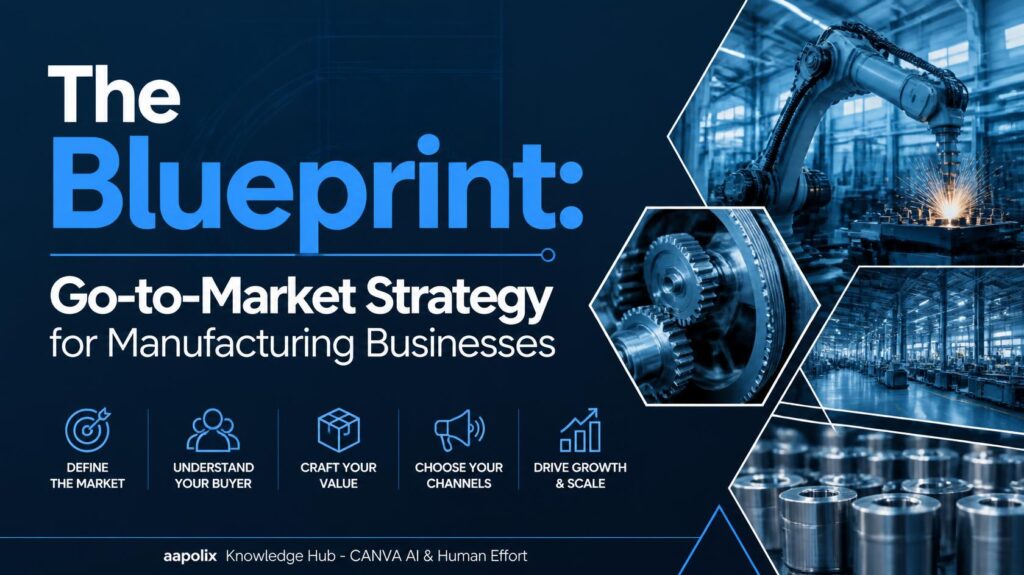
What Is a Go-to-Market Strategy?
A Go-to-Market strategy is a practical plan for taking your product or service to the right market.
For a manufacturing business, it means answering five simple questions:
- Who is the customer?
- What problem are we solving?
- Why should they choose us?
- Where will they find us?
- How will an enquiry become a customer?
It is not just about marketing. A good GTM strategy connects your product, market, marketing, sales and customer journey.
Why Manufacturing Businesses Need a GTM Strategy
A manufacturing company can have excellent machinery, skilled people and years of experience — and still struggle to generate new enquiries.
Good production does not automatically create demand.
Your potential buyers may simply not know what you can do, who you serve or how to start a conversation with you.
- Buyers may not know your company exists.
- Your website may not clearly explain your capabilities.
- Your marketing may try to reach everyone.
- New business may depend heavily on referrals.
- Enquiries may not be followed up consistently.
- Marketing and sales may work separately.
A GTM strategy brings these pieces together so that your manufacturing capability has a clear route to the right buyers.
How to Build a Go-to-Market Strategy for Manufacturing
1. Know Your Customer
Start with the businesses most likely to need what you make.
For example, a laser cutting company may work with:
- HVAC manufacturers
- Engineering companies
- OEMs
- Fabricators
- Procurement teams
Instead of saying, “We provide laser cutting for everyone,” start with the customer groups you understand best.
A focused customer group makes your website, content, sales message and marketing much clearer.
2. Understand the Customer’s Problem
Manufacturing buyers do not simply buy a process. They are usually trying to solve a business or production problem.
They may be looking for:
- Faster production
- Consistent quality
- Lower rejection
- Reliable delivery
- Better pricing
- Additional production capacity
- A reliable local supplier
- Technical capability
Your message should therefore start with the buyer’s requirement, not only your machinery or production process.
3. Be Clear About What You Provide
A buyer should understand your offer within a few seconds.
For example:
Instead of: Precision Engineering Solutions
Say: Precision laser cutting for industrial components and production requirements.
Clear language helps both people and search engines understand what your business actually provides.
4. Define Your Market
A simple way to begin is:
One product + one customer group + one market.
For example:
- Laser Cutting + HVAC Manufacturers + Bangalore
- Powder Coating + Industrial Fabricators + Bommasandra
This does not mean you can only serve one market forever. It gives you a clear starting point.
Once one market is understood, the same framework can be expanded into other industries, locations and product categories.
5. Create a Clear Positioning
Why should a buyer consider your company?
Your positioning may be based on:
- Capability
- Quality
- Speed
- Location
- Industry experience
- Technical expertise
- Production capacity
- Service
- Reliability
You do not need to call yourself the “best manufacturer.” Show buyers what you can actually do and give them enough evidence to make an informed decision.
6. Choose the Right Marketing Channels
You do not need to be everywhere.
You need to be where your buyers are looking.
Search
Buyers search for products, processes, suppliers, materials and solutions. SEO can help your business appear when that demand already exists.
Content
Useful content can answer technical and commercial questions before a buyer contacts your sales team.
LinkedIn can help manufacturing businesses reach professionals, decision-makers and companies within specific industries.
Local Search
Local visibility can be important when your business serves Bangalore, Bommasandra, Electronic City or nearby industrial areas.
Paid Marketing
Paid campaigns can be useful when you need faster visibility around a specific product, service or offer.
Direct Sales
When you already know the companies you want to work with, direct sales and account-based outreach can become part of the GTM process.
The point is simple: do not choose channels because everyone else is using them. Choose the channels your buyers actually use.
7. Build Pages That Generate Enquiries
Getting someone to your website is only the beginning.
A manufacturing service or landing page should quickly answer:
- What do you make?
- Who do you serve?
- What can you handle?
- Where are you located?
- Why should I trust you?
- What should I do next?
Each important capability can eventually have its own focused page. This creates a scalable website structure where products, industries, applications, locations and supporting content can grow without making the website confusing.
8. Connect Marketing With Sales
A marketing campaign should not end when someone submits an enquiry.
The journey should continue:
Visitor → Enquiry → Lead → Follow-up → Quote → Customer
When marketing, CRM and sales follow-up are connected, the business can see what happens after a visitor becomes an enquiry.
9. Build Trust Before the Sales Call
Industrial buyers often need evidence before they are ready to discuss a requirement.
Show the things that help them understand your capability:
- Machinery
- Materials
- Production capacity
- Certifications
- Quality processes
- Case studies
- Industries served
- Project examples
- Factory photographs
- Technical information
Industrial buyers want evidence. Give them evidence.
10. Measure the Journey
Do not stop at website traffic.
Track the journey from attention to business:
Traffic → Enquiries → Qualified Leads → Quotes → Orders → Revenue
The purpose of measurement is not to collect more numbers. It is to understand which activities are creating better business opportunities.
A Simple GTM Framework for Manufacturers
If the complete GTM process feels complicated, start with these eight questions:
- Who are we trying to reach?
- What problem do they have?
- What are we selling?
- Why should they consider us?
- Where will they find us?
- How will they contact us?
- How will we follow up?
- What is working?
These questions can become the foundation for your marketing plan, website structure, sales process and measurement system.
Go-to-Market Example for a Manufacturing Company
Consider a laser cutting company in Bangalore.
Business: A laser cutting company in Bangalore.
Problem: Most new business comes through referrals.
Target: HVAC manufacturers and engineering companies.
Offer: Industrial laser cutting for production and custom components.
Marketing: SEO + industry content + landing pages + LinkedIn.
Conversion: Request-a-Quote landing page.
Sales: CRM + enquiry tracking + follow-up.
Measurement: Enquiries → qualified leads → quotations → orders.
The GTM strategy connects the factory’s capability with the buyers who need that capability.
That is the difference between simply having a website and building a system that helps turn market demand into business opportunities.
GTM Is More Than Marketing
Marketing gets attention.
Sales develops the opportunity.
Operations delivers the promise.
CRM keeps the process organised.
GTM connects all of them.
This is why a Go-to-Market strategy should not be treated as another name for digital marketing. It is a broader business process that connects what the company offers with how customers discover, evaluate and buy it.
Common Go-to-Market Mistakes in Manufacturing
Trying to Reach Everyone
A broad audience usually creates a broad message. When everyone is the target customer, it becomes difficult to explain why your company is relevant to a specific buyer.
Talking Only About Machinery
Machines are proof of capability. They are not necessarily the customer’s problem.
Show the machine, but also explain what it helps the customer achieve.
Focusing Only on Website Traffic
Traffic is useful, but traffic without relevant enquiries does not create business.
Look at what happens after people reach your website.
Depending Only on Referrals
Referrals can be valuable, but they should not have to carry the entire responsibility for finding new business.
A stronger GTM system creates additional ways for potential buyers to discover your company.
Marketing Without Sales Follow-Up
A good enquiry can become a lost opportunity if nobody follows up at the right time.
Marketing and sales need a connected process.
Changing Marketing Without Measuring
Every campaign should have a clear objective.
Measure what happened, learn from it and then decide what should change.
How Aapolix Helps Manufacturing Businesses Go to Market
You make the product. We help you find the buyers.
Aapolix approaches manufacturing growth as a connected system rather than a collection of separate marketing activities.
Reach
Get seen by the right buyers.
- SEO
- Content marketing
- Industrial marketing
- Social media
- Search visibility
Explore Aapolix Marketing Solutions
Connect
Turn attention into opportunity.
- Landing pages
- Lead generation
- CRM
- Sales funnels
- Enquiry tracking
Explore Aapolix Lead Generation Solutions
Manage
Keep the business organised as it grows.
Marketing and lead generation create opportunities. Business management helps keep the work, processes and follow-up organised as those opportunities move forward.
Explore Aapolix Business Solutions
Start Small. Learn. Then Grow.
You do not need a complicated GTM plan to get started.
Start with:
- One product.
- One customer group.
- One problem.
- One clear message.
- One path to enquiry.
Then measure what happens.
Learn from the market.
Improve.
Grow.
Once the process works, it can be expanded into additional products, industries, locations and customer groups.
Frequently Asked Questions About Go-to-Market Strategy
What is a Go-to-Market strategy?
A Go-to-Market strategy is a plan for reaching the right customers, communicating your offer, generating demand and turning customer interest into sales.
Why do manufacturing businesses need a GTM strategy?
Manufacturing businesses can have strong products and production capabilities but still struggle to consistently reach new buyers. A GTM strategy connects the product, target market, marketing, sales and customer journey.
What should a manufacturing GTM strategy include?
It should define the target customer, customer problem, offer, positioning, marketing channels, lead-generation process, sales journey and key measurements.
Is GTM the same as a marketing strategy?
No. Marketing is one part of GTM. A GTM strategy connects the market, positioning, marketing, sales and customer journey.
How can SEO support a manufacturing GTM strategy?
SEO can help manufacturers appear when buyers search for products, processes, suppliers and solutions. It can bring relevant visitors to service pages, product pages and educational content.
How long does a GTM strategy take?
There is no single timeline. A simple GTM plan can start with one product, one target customer group and one market, then improve as the business learns from enquiries and sales.
Can a small manufacturing company use a GTM strategy?
Yes. GTM is not only for large companies. A small manufacturer can start with a focused customer group, a clear offer and a simple path from marketing to enquiry.
What is the difference between GTM and lead generation?
Lead generation focuses on creating enquiries. GTM is broader. It covers the market, customer, positioning, channels, messaging, lead generation and sales journey.