
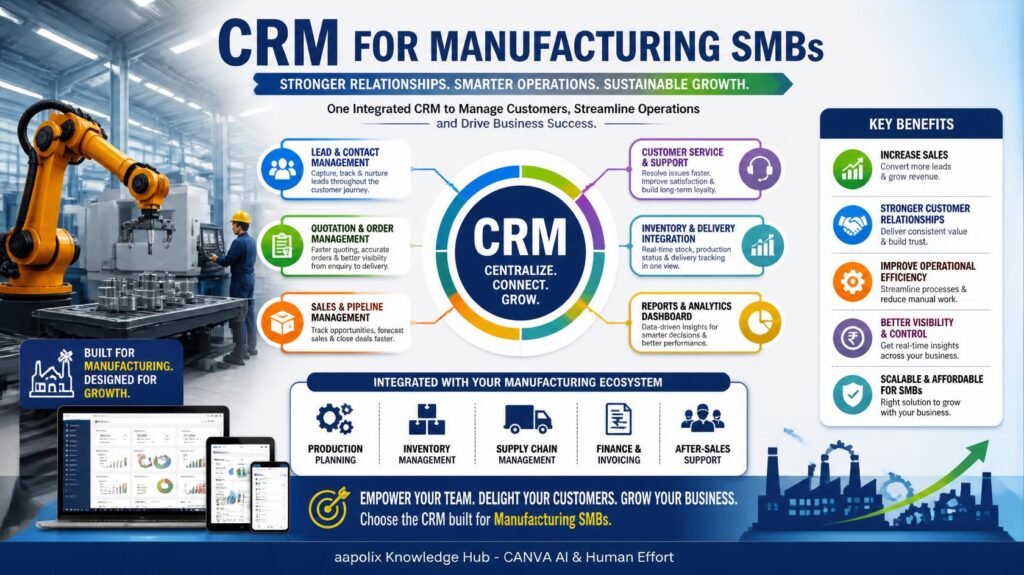
The enquiry came in on Monday morning. A new customer wanted a quotation. The requirement looked genuine. The sales team discussed it, asked for the drawing, checked the quantity and promised to send the quote.
Then the week became busy. Another customer called. A production issue needed attention. A supplier was waiting for confirmation. Someone sent a quotation through email. Another enquiry arrived through the website.
Two weeks later, the first customer called again.
“Did you get my requirement?”
Someone searched through an inbox. Someone checked WhatsApp. Someone opened a spreadsheet. The enquiry was there.
What was missing was the next action. This is where the CRM conversation really starts for a manufacturing SMB.
The problem is usually not a lack of customer enquiries. The problem is what happens to those enquiries after they arrive.
For a manufacturing business, a customer relationship can move through several stages before an order is finally received: enquiry, technical discussion, drawing review, quotation, negotiation, follow-up, sample, approval, purchase order and repeat business.
When all of this information sits across email, spreadsheets, phones and individual salespeople, it becomes difficult to see the complete picture.
That is why choosing the right CRM for a manufacturing business needs more thought than simply asking which software has the most features.
Why Manufacturing Companies Need More Than a Contact List
A basic contact list can tell you who the customer is. It cannot necessarily tell you what the customer wanted, what was quoted, who is responsible for the follow-up, what technical information was received or why the opportunity was lost.
Manufacturing sales are rarely just a conversation between a salesperson and a customer. A typical enquiry may involve a drawing, material specification, quantity, tolerance, delivery requirement, inspection requirement and commercial discussion.
- One customer may ask for laser cutting.
- Another may need fabrication and welding.
- Another may send a drawing and ask whether the company can manufacture the component at the required quantity and tolerance.
- The sales team needs to know what happened at every stage.
A useful manufacturing CRM should therefore help the business answer simple questions quickly:
- Where did this enquiry come from?
- What exactly does the customer need?
- Who is handling it?
- Has the technical requirement been understood?
- Was a quotation sent?
- When should the customer be contacted again?
- What is the expected order value?
- Why was the opportunity won or lost?
- When might the customer need the service again?
These questions sound simple. But when the answers are spread across five different places, managing the sales pipeline becomes much harder than it should be.
CRM vs ERP: They Are Not the Same Thing
This is one of the first things a manufacturing SMB should understand before selecting software.
A CRM manages the customer and sales relationship. An ERP manages broader business operations and transactions.
A CRM may manage the journey from a new enquiry to a purchase order. An ERP may manage what happens after the order enters the operational side of the business.
For example, a CRM may contain:
- Leads
- Customer contacts
- Sales opportunities
- Enquiries
- Quotations
- Follow-ups
- Sales activities
- Customer communication history
An ERP may contain:
- Inventory
- Purchase orders
- Bill of materials
- Production planning
- Work orders
- Dispatch
- Invoicing
- Accounts
There can be overlap between systems, and the exact boundaries depend on how the business is set up.
The important point is that a manufacturing company should not automatically expect a CRM to run production or expect an ERP to manage every part of the sales relationship. In many businesses, the better answer is to connect the two.
HubSpot for Manufacturing SMBs
For a growing manufacturing company, the first requirement may simply be better control over enquiries and follow-ups.
The business may already have a website generating enquiries. Salespeople may be receiving calls and emails. Marketing may be generating leads through search, social media or campaigns.
The challenge is bringing these conversations into one place.
A CRM such as HubSpot can be used to structure this part of the business around contacts, companies, enquiries, sales opportunities, communication and follow-up activities. For a manufacturing SMB, the useful question is not whether the platform has hundreds of features.
The useful question is:
Can our sales team use it to manage the customer journey consistently?
For example, a manufacturing enquiry could move through a simple pipeline:
New Enquiry → Requirement Understood → Technical Review → Quotation Sent → Follow-up → Negotiation → Won / Lost
That alone can create much better visibility than maintaining separate spreadsheets for every salesperson. However, manufacturing businesses should also understand the boundary.
If the business needs detailed production planning, inventory control, complex manufacturing calculations or highly specialized operational workflows, a CRM may need to work alongside an ERP or another manufacturing system.
Salesforce for Manufacturing Businesses
As a manufacturing business grows, its sales process can become more complicated. There may be several salespeople, different customer groups, multiple locations, distributors, large accounts and more detailed approval processes.
This is where an enterprise CRM approach can become relevant. Salesforce can support complex customer and sales processes and can be configured around the way an organization works.
For a manufacturing company, this can be useful when the sales operation needs more than a simple lead-to-quotation pipeline.
For example, the business may need different workflows for:
- Existing customers
- New accounts
- OEM enquiries
- Distributor enquiries
- Large project opportunities
- Repeat production requirements
- Multiple decision-makers within one customer account
But there is another side to this. A powerful CRM can also require more planning, configuration, training and ongoing management.
For a smaller manufacturing business, buying a large system before understanding the actual sales process can create unnecessary complexity. The software should follow the business requirement, not the other way around.
HubSpot vs Salesforce vs Custom ERP: What Should a Manufacturing SMB Look At?
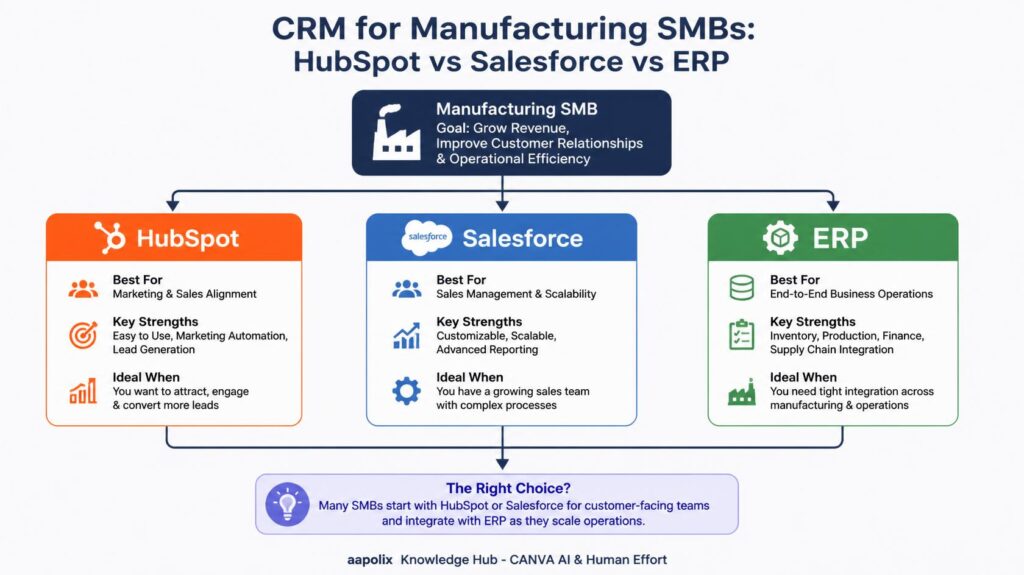
There is no single system that fits every manufacturing business.
The decision becomes easier when the comparison starts with business requirements instead of software names.
| Requirement | CRM Platform | Enterprise CRM | Custom ERP |
|---|---|---|---|
| Lead capture | Strong fit | Strong fit | Depends on implementation |
| Sales pipeline | Strong fit | Strong fit | Can be customized |
| Marketing automation | Strong fit | Strong fit | Usually requires additional work |
| Complex manufacturing workflow | May need integration | May need integration | Can be built around the workflow |
| Production management | Not the primary purpose | Not the primary purpose | Can be a core function |
| Inventory management | Usually requires integration | Usually requires integration | Can be integrated or built in |
| Custom workflow | Good | Extensive | Highly customizable |
| Implementation complexity | Lower | Higher | Highest |
This table is only a starting point. The right choice depends on the size of the sales team, the complexity of the manufacturing process, the existing technology stack and how much integration the business actually needs.
When a Custom ERP or Manufacturing System Makes More Sense
Some manufacturing companies eventually reach a point where their requirements go beyond traditional CRM functionality. The sales team may need to know production capacity before confirming a quotation.
A quotation may depend on material, thickness, quantity, machine time, tooling, finishing, transport and customer-specific pricing.
The customer may send drawings and technical documents that need to move through several internal teams. In such situations, the business may need a deeper connection between sales and operations.
A custom ERP or manufacturing management system can be considered when the workflow itself is highly specific to the company.
Examples may include:
- Custom quotation calculations
- Customer-specific pricing
- Material requirements
- Production planning
- Machine capacity
- Drawing and document workflows
- Job tracking
- Inventory management
- Dispatch management
- Accounts integration
But there is an important warning for SMBs.
A custom system should not be built simply because the existing spreadsheet looks messy.
Before building anything, the business should understand the process that is actually causing the problem. Sometimes the problem can be solved with a better CRM process. Sometimes an existing ERP already has the required functionality. Sometimes the right answer is integration between systems. And sometimes a customized application is justified because the company’s workflow is genuinely different.
The Real Question: Where Does Your Customer Journey Break?
Instead of asking, “Which CRM should we buy?”, start with a different question.
“Where are we losing visibility in the customer journey?”
Look at the last few enquiries that came into the business.
- Can you quickly find them?
- Can you see who handled each enquiry?
- Can you see whether a quotation was sent?
- Can you see when the next follow-up is due?
- Can your sales manager see all open opportunities without calling every salesperson?
- Can the business identify why quotations were lost?
- Can someone understand the complete customer history if the salesperson handling the account is unavailable?
If the answer to several of these questions is no, the business may have a process problem that a CRM can help solve.
There may be other signs as well.
- Website enquiries are forwarded manually to salespeople.
- Quotation follow-ups depend on personal reminders.
- Customer information is stored in individual spreadsheets.
- Sales managers ask for pipeline updates manually.
- Important conversations remain inside personal WhatsApp accounts.
- Lost enquiries are rarely recorded properly.
- Repeat customers have to explain their requirements again.
These are not simply software problems.They are signs that the customer journey needs a clearer process.
Start With the Manufacturing Sales Process, Not the Software
Before choosing a CRM, map the process on paper. It does not need to be complicated.
Start with:
Enquiry → Qualification → Technical Discussion → Quotation → Follow-up → Negotiation → Order → Repeat Business
Then ask what information is required at each stage. A laser cutting company may need material, thickness, drawing, quantity and delivery requirement.
A fabrication company may need dimensions, material grade, welding requirements, surface treatment and inspection requirements.
A contract manufacturer may need drawings, specifications, annual volumes, target pricing and delivery schedules.
The CRM should capture the information that the sales team actually needs to move the opportunity forward. That is more important than having a long list of software features.
What a Manufacturing CRM Should Actually Track
A manufacturing CRM should be designed around the way the business sells.
Depending on the industry and sales process, useful fields may include:
- Company name
- Contact person
- Industry
- Requirement
- Product or service
- Material
- Quantity
- Drawing or specification
- Expected order date
- Estimated opportunity value
- Lead source
- Salesperson
- Current sales stage
- Quotation number
- Quotation date
- Next follow-up date
- Next action
- Lost reason
Not every company needs every field. The goal is to capture enough information for the next person in the process to understand what is happening without starting the conversation again from zero.
Connecting REACH to CONNECT
There is another reason CRM becomes important for manufacturing businesses. Getting found is only the first part of the process. A manufacturer may invest in SEO, Google search, industrial content, landing pages, LinkedIn or paid campaigns.
Those activities can bring a potential customer to the website. The customer may then submit an enquiry. That is where the responsibility moves from REACH to CONNECT.
The website has created the opportunity. The CRM needs to help the business handle it. A simple flow could look like this:
Search → Website → Enquiry → CRM → Sales Owner → Technical Review → Quotation → Follow-up → Order
If the first half of this journey is well managed but the enquiry disappears after submission, the business has only solved half the problem.
This is why CRM should not be treated as a separate software project sitting away from marketing. The website, lead-generation process, sales team and CRM should work as one customer journey.
How to Start Without Overbuilding
Manufacturing SMBs often make the same mistake when they start a digital transformation project. They try to solve everything at once.
CRM, ERP, automation, dashboards, inventory, production, marketing and reporting all become part of one large project. The result can be expensive and difficult for the team to adopt. A better starting point is smaller.
Stage 1: Capture every enquiry.
Make sure website, campaign and sales enquiries have a clear destination.
Stage 2: Create a consistent sales pipeline.
Give every salesperson the same basic stages and definitions.
Stage 3: Track quotations and follow-ups.
Make the next action visible instead of depending on memory.
Stage 4: Connect lead sources.
Bring website forms and other relevant sources into the same process.
Stage 5: Connect CRM with other business systems.
Once the sales process is working, connect the CRM with ERP, accounting, operations or other systems where there is a genuine business need.
Stage 6: Automate repetitive work.
Only after the process is understood should the company automate reminders, notifications, reports and routine follow-ups.
This approach makes the technology easier to manage because the business is improving a known process rather than trying to discover the process inside the software.
The Best CRM Is the One Your Sales Team Actually Uses
There is one practical test that matters more than a long feature list. Will the sales team actually use the system?
A CRM can have advanced dashboards, automation and integrations, but if salespeople continue keeping customer information in personal spreadsheets and WhatsApp conversations, management will still have the same visibility problem.
The system needs to be simple enough for everyday use.
A salesperson should be able to open an opportunity and quickly understand:
- Who the customer is
- What they need
- What was discussed
- What was quoted
- What happens next
That is the practical value of a CRM.
Conclusion: Choose the System Around the Business, Not the Other Way Around
A manufacturing SMB does not automatically need the biggest CRM available. It needs a system that gives the business visibility from the first enquiry to the next order.
For some businesses, a dedicated CRM platform may be enough to bring structure to lead management, quotations and follow-ups.
For a larger or more complex sales operation, an enterprise CRM may provide the customization and integration required.
For businesses with highly specific production and operational workflows, a custom ERP or connected manufacturing system may make more sense.
And in many cases, the answer is not CRM or ERP. It is CRM and ERP, with each system handling the work it is designed to manage. The decision should start with the process.
- Where does the enquiry come from?
- Who handles it?
- What information is required?
- Where does the quotation happen?
- How is follow-up managed?
- What happens when the customer places an order?
Once those questions are clear, choosing the technology becomes much easier. Because the goal of a manufacturing CRM is not to give the business another piece of software. The goal is to make sure a good customer enquiry does not get lost between the first conversation and the final order.
Frequently Asked Questions
What is the best CRM for a manufacturing company?
There is no single CRM that is right for every manufacturing company. The choice depends on the size of the sales team, the complexity of the sales process, existing ERP systems, integration requirements and how much customization the business needs.
Is a CRM necessary for a small manufacturing business?
A small manufacturing company can manage early-stage sales with spreadsheets and simple tools. As enquiries, customers and salespeople increase, it can become difficult to track quotations, follow-ups and customer history manually. This is often the point where a CRM becomes useful.
What is the difference between CRM and ERP in manufacturing?
A CRM primarily manages customer relationships, sales enquiries, opportunities and follow-ups. An ERP generally manages wider business operations such as inventory, purchasing, production, dispatch and accounting. A manufacturing company may use one system, separate systems or an integrated combination depending on its requirements.
Can a manufacturing company use HubSpot as its CRM?
Yes. A CRM platform such as HubSpot can be used to organize contacts, companies, enquiries, sales opportunities and follow-ups. If the company has complex production, inventory or operational requirements, the CRM may need to work alongside an ERP or another business system.
Is Salesforce suitable for manufacturing companies?
Salesforce can support complex customer and sales processes and can be configured for organizations with more advanced requirements. A manufacturing business should consider implementation, customization, integration and ongoing management requirements before selecting an enterprise CRM.
Should a manufacturing company build a custom ERP?
Not automatically. A custom ERP makes more sense when a company’s operational workflows have specific requirements that existing systems cannot reasonably support. The business should first map its processes and identify the actual gaps before deciding to build custom software.
Can CRM and ERP work together?
Yes. CRM and ERP systems can work together so that sales teams can manage customer relationships while operational teams manage production, inventory, purchasing, finance or dispatch. The exact integration depends on the systems and processes used by the business.
What should a manufacturing CRM track?
Depending on the business, useful information can include customer details, enquiry source, product or service requirement, material, quantity, drawings, quotation details, opportunity value, salesperson, sales stage, follow-up date, next action and lost reason.
Explore Aapolix Connect for lead generation, CRM, sales funnels and enquiry management solutions for growing businesses.