
Why Fabrication & Interior Businesses Lose High-Value Projects Online
This is exactly what is happening in most fabrication and interior businesses today. Many companies are doing solid work. Clients are satisfied, and a large part of their business still comes from referrals and repeat projects.
But online enquiries often remain inconsistent. The reason is simple — buyers are no longer making quick decisions. Whether it’s a fabrication contractor, interior designer, or fit-out service provider, people now spend time researching before they reach out.
They look at multiple companies, compare past work, and try to understand who is most reliable for their project. So if your website doesn’t clearly explain what you do, what type of projects you handle, and what results you’ve delivered, many potential clients will quietly move on — even if your work is better.
By the time someone contacts you, they’ve usually already done most of their evaluation. That’s why your online presence is no longer just a marketing tool. It has become part of the decision-making process itself.
For a more practical guide on improving this, you can explore our Insights.
Why High-Value Projects Are Lost Before the First Conversation
Many business owners assume they’re losing opportunities because competitors are cheaper. In reality, prospects often choose another supplier because they found clearer information, stronger project evidence, or greater confidence in that company’s ability to deliver.
Common reasons projects are lost
In most cases, opportunities are not lost because of poor work, but because of how the business is presented online.
In many cases, improving these fundamentals can generate better results than increasing advertising spend.
A Practical Framework for Improving Online Visibility
There is no single marketing tactic that solves this challenge. Companies that consistently attract quality enquiries usually focus on a few key areas and execute them well.
Step 1: Clearly Define Your Services
Instead of trying to explain everything on one page, create separate pages for each key service.
| Service Category | Example |
|---|---|
| Custom Fabrication | Metal fabrication, laser cutting, structural works |
| Interior Solutions | Modular kitchens, office interiors, retail fit-outs |
| Commercial Projects | Warehouses, industrial facilities, commercial spaces |
This helps search engines understand your expertise and makes it easier for customers to find relevant services.
Step 2: Showcase Real Project Experience
Most companies talk about expertise. Fewer actually show proof.
- Project scope
- Client industry
- Key challenges
- Solution delivered
- Before-and-after images
- Measurable outcomes
This kind of proof often influences decisions more than any marketing message.
Step 3: Create Industry-Specific Content
Different industries look for different things. Your content should reflect that.
- Manufacturing
- Retail
- Hospitality
- Residential Construction
- Commercial Real Estate
Industry-focused pages improve both trust and search visibility for long-tail keywords.
Step 4: Make Enquiries Easy
Many businesses lose enquiries simply because it is not easy to contact them.
- Simple enquiry forms
- Click-to-call buttons
- WhatsApp integration
- Consultation booking links
- Downloadable capability profiles
The easier the process, the higher the chances of conversion.
Step 5: Measure What Matters
| KPI | Why It Matters |
|---|---|
| Organic Traffic | Shows visibility in search results |
| Enquiry Volume | Measures lead generation |
| Conversion Rate | Indicates lead quality |
| Project Value | Connects marketing to revenue |
The goal is not more data, but better decisions based on real business outcomes.
Turning Visibility Into Better Enquiries
We recently worked with a fabrication and interior business that mainly depended on referrals and repeat customers. The company already had strong work and a good reputation, but its website didn’t really show that clearly. Important project details were hard to find, service pages were not very clear, and there was very little content
that spoke directly to specific industries they served. After improving service pages, adding real project examples, and creating industry-focused content, the quality of enquiries started improving noticeably.
The interesting part was not just more traffic. The real improvement was in the conversations. People who reached out already had a better understanding of the company’s capabilities, pricing expectations,
and project requirements.
This helped shorten the sales cycle and made discussions much more productive.
What Makes a High-Performing Fabrication or Interior Website?
A good website should make things simple for your potential clients. Within a few seconds, they should clearly understand what you do, whether you’ve handled similar projects, and how they can reach you.
Most enquiries are lost not because of poor capability, but because this information is not clear enough on the website. A high-performing fabrication or interior website usually brings everything together in a structured way so buyers can quickly build trust.
Key elements of an effective website:
- Clear service pages that explain exactly what you offer
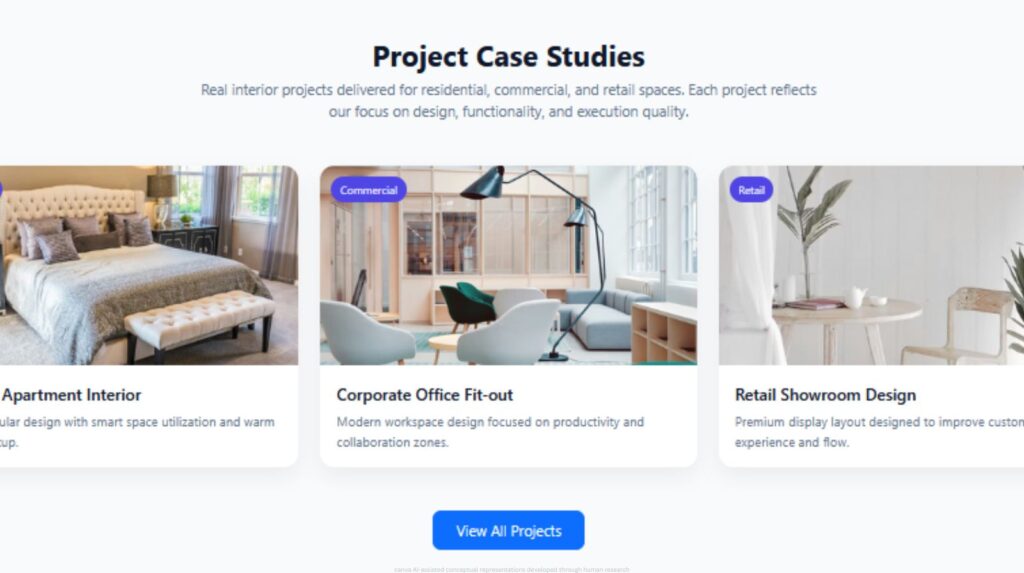
- Real project case studies with visuals and outcomes
- Industry-specific pages (manufacturing, retail, residential, etc.)
- Strong trust signals like testimonials and past clients
- Simple enquiry options (form, call, WhatsApp)
- Mobile-friendly and fast-loading design
When these elements work together, your website doesn’t just look good — it starts generating better-quality enquiries.
Leave a Reply